
Rappahannock Projected and Actual Release Dates
Virginia records use several date types that should not be collapsed into a single “release date.” VADOC Operating Procedure 050.6 permits disclosure of projected parole-eligibility, mandatory-parole, and good-time release dates at the time of an inquiry. A parole-eligibility date marks when consideration may begin. A mandatory-parole or good-time date follows the law and sentence computation that applies. The actual release date records the completed custody transaction.
For Rappahannock County, the custodian is decisive. RSW maintains the local jail transaction. VADOC maintains state-prison sentence computations and says a person satisfying a VADOC term leaves by discharge or parole and receives a notification-of-release letter. A Rappahannock court order supplies the legal basis, yet another warrant, detainer, or case can prevent community release even when one order appears to authorize it.
A person awaiting trial at RSW has no sentence-based projected date. Bond may permit release if its terms are met, and a judge may change custody through a later order. The actual jail exit still requires RSW processing. If the person is absent from the current RSW locator, the result is “not shown, outcome unconfirmed” until RSW, Virginia Jail VINE, a court record, or a receiving agency supplies a positive event.
Find a Rappahannock Projected Release Date
Begin with the sentence location, not the arrest location. A Rappahannock County prosecution can lead to a sentence served at RSW or commitment to a VADOC facility elsewhere in Virginia. It can also lead to federal custody in a separate case. Each system computes and reports dates differently, so one search cannot answer all three. The Rappahannock County released-inmate search maps those custody systems when the responsible authority is not yet clear.
- Check the court case and determine whether the person is pretrial, locally sentenced, state-responsible, or federally sentenced.
- For VADOC responsibility, use the official Inmate and Supervisee Locator. Search by the seven-digit DOC ID when possible, or use the required name fields and reliable filters.
- Read custody or location separately from supervision and date fields. Preserve the exact wording, such as projected parole eligibility, mandatory parole, or good-time release date.
- For a sentence served at RSW, ask Records for the computed date and the inputs used, including commitment terms and jail credit. Compare them with the court order.
- For a pretrial detainee, check bond and later orders in the correct Rappahannock court, then ask RSW whether an actual release or transfer occurred.
- On or after a projected date, recheck status and seek the release letter, Order of Release, or booking-and-release transaction.
The VADOC locator says it is updated daily and covers people in VADOC custody or under VADOC supervision. It is not a historical archive of every former RSW detainee or every fully discharged Virginia prisoner. A county sentence served entirely at RSW may never create the state search record a reader expects.
The source below explains how VADOC computes time and distinguishes the sentence systems that may apply.
Review the official VADOC time-computation guidance before interpreting a state date.
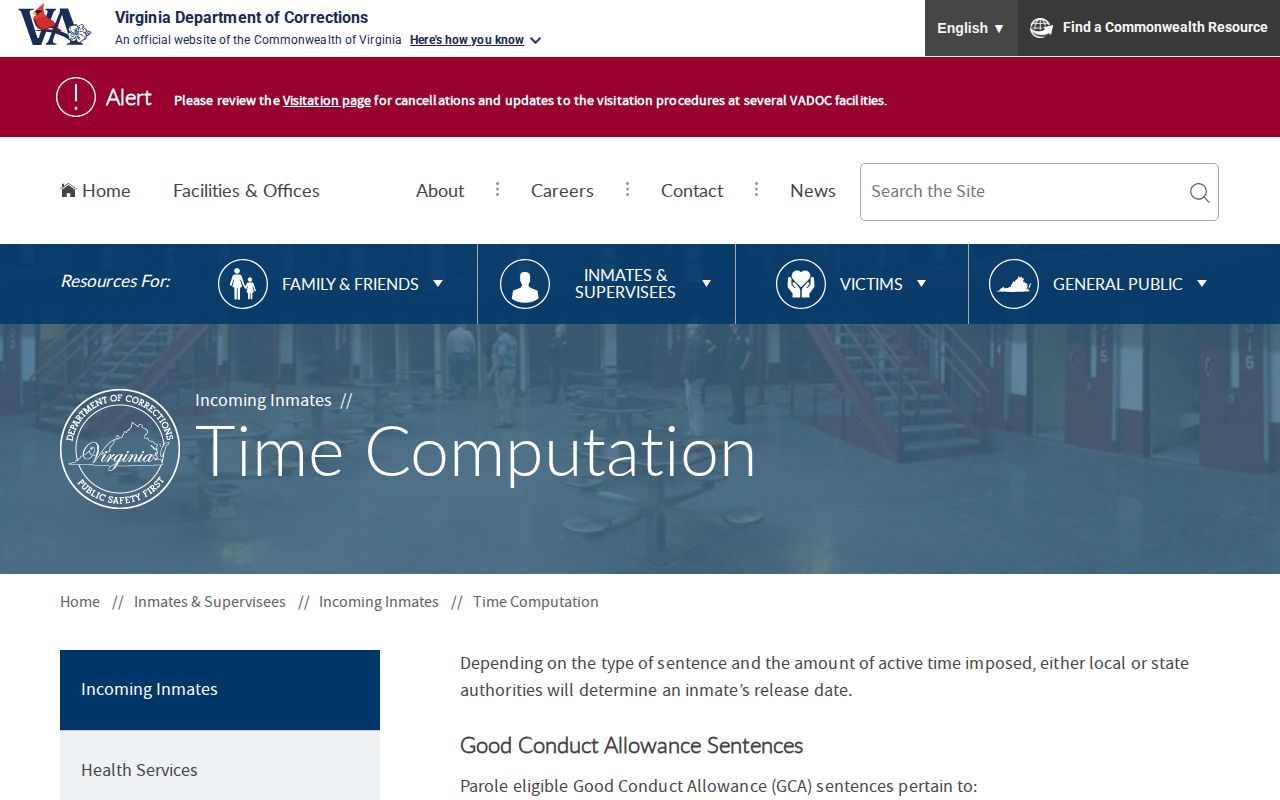
The page provides the agency context for the displayed date, while the individual's live VADOC record supplies the exact current label.
Rappahannock State Release Credit Rules
Virginia Code § 53.1-202.2 applies earned-sentence-credit rules to felony offenses committed on or after January 1, 1995, in state or local correctional facilities. One credit equals one day deducted. Section 53.1-202.3 sets the earning rates, and the rate depends on both the offense category and the person's current earning level.
Enumerated offenses in § 53.1-202.3(A) are limited to 4.5 days of credit for each thirty days served. Other eligible offenses can fall into levels providing fifteen, 7.5, 3.5, or zero days per thirty days. The earning level is reviewed at least annually and may change after discipline or removal from a program. Earned credits do not reduce the waiting period for parole eligibility.
This is why “serve 85 percent” is not a universal Virginia formula. That phrase roughly describes the restricted 4.5-day rate, but it does not account for all eligible offenses, earning levels, older sentence systems, mandatory minimums, or local misdemeanor rules. A Rappahannock projected release date should come from the official computation, not a percentage applied to the sentence in isolation.
The official Virginia earned-credit rate statute shows the offense and level structure used in the state framework.
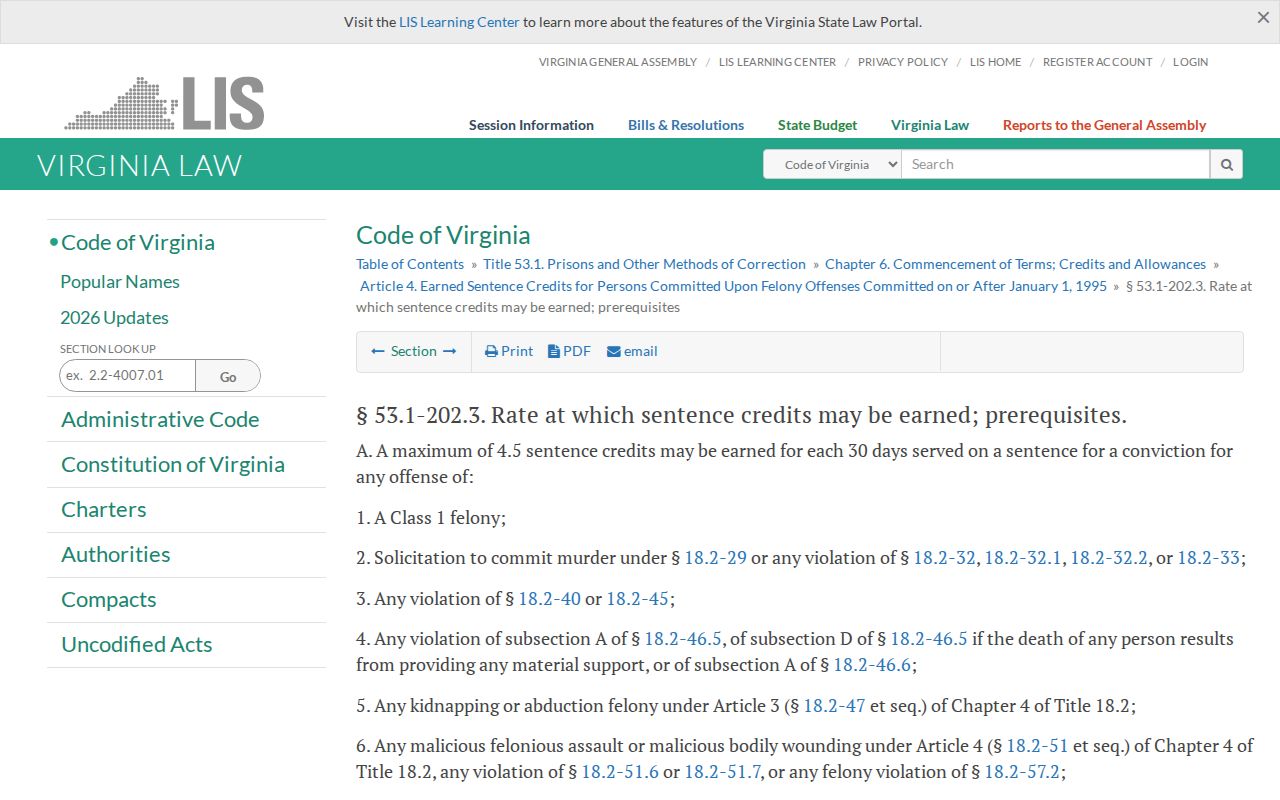
The statute image shows why the current earning class must be known before a credit rate can be connected to a particular sentence.
Note: A posted VADOC date is a time-of-inquiry projection and can change when sentence or custody inputs change.
RSW Local Release-Date Computation
RSW Regional Jail can hold a person before trial, serve as the place for a local sentence, or hold someone awaiting transfer. The date question changes with that status. Virginia Code § 53.1-21 generally keeps terms of twelve months or less local unless the VADOC Director consents, and it also addresses combined state-responsible terms. The court's sentence and the authority responsible for computation must be identified before choosing the correct office.
Under Virginia Code § 53.1-116, the jailer maintains records of the commitment, term, offense, receipt, prisoner, and earned credits, along with a written policy for credit awards and revocation. Unless a mandatory minimum controls, a misdemeanor sentence of twelve months or less earns one credit day for each compliant day served, including qualifying pretrial days. The statute also describes other categories and possible local activity credits.
The exact RSW calculation still requires the commitment order, credited pretrial confinement, concurrent or consecutive terms, mandatory-minimum language, and the facility's written policy. If a Rappahannock court imposed more than one term, a single sentence length cannot show whether those terms overlap or run one after another. Ask for the computation or the releasable inputs rather than asking staff to endorse an outside estimate.
The local jail credit statute is the source for this county-jail calculation distinction.
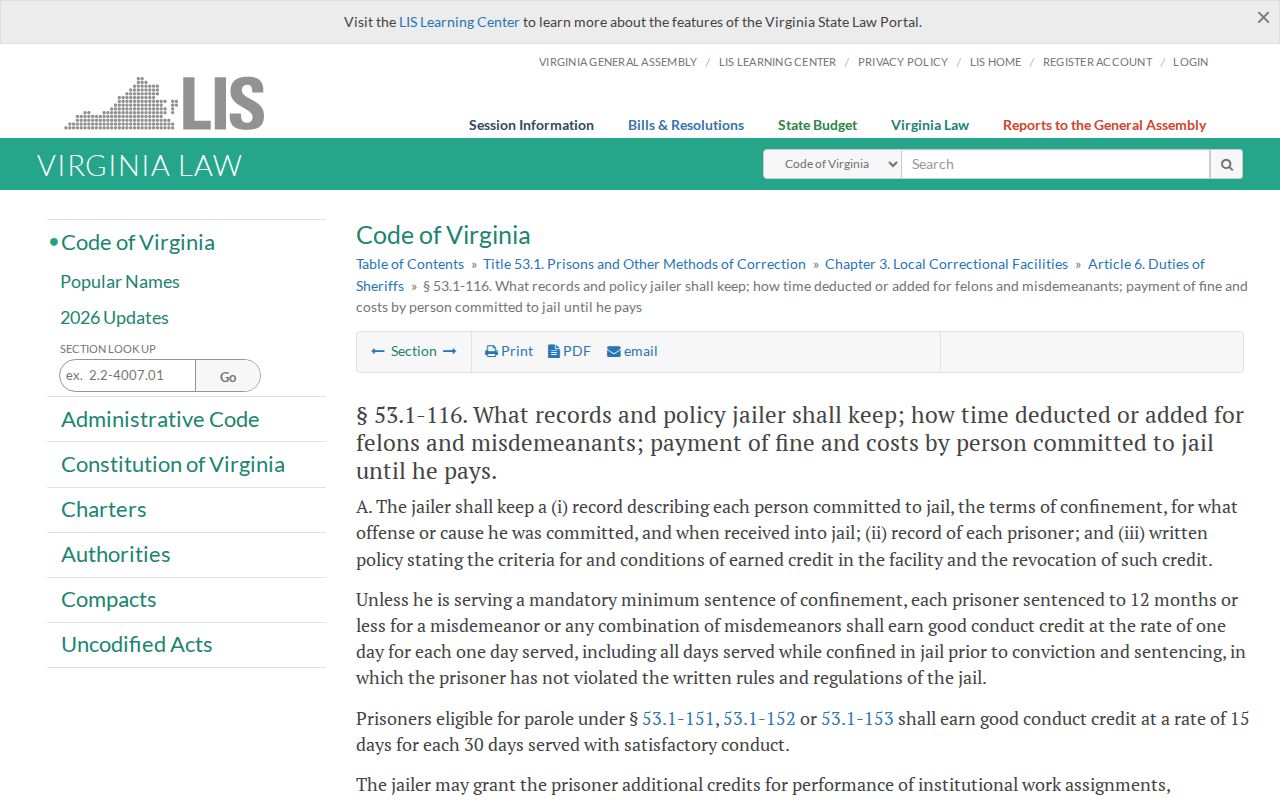
The local rule pictured here is not interchangeable with VADOC's felony earned-credit level table, even when both affect a projected date.
Why Rappahannock Release Dates Change
A release date is the output of many inputs. VADOC's release-day process checks electronic and paper records for outstanding problems before staff complete the event. RSW likewise must follow the controlling court commitments and any lawful holds. A change does not by itself show error, early release, or misconduct.
| Factor | Possible effect on the date or outcome |
|---|---|
| Pretrial credit | Verified qualifying days can reduce the remaining active term. |
| Concurrent or consecutive terms | Terms may overlap or run in sequence under the sentencing orders. |
| Earned-credit level | A new level can change the pace at which eligible credit accrues. |
| Discipline or program removal | Credit earning or previously expected computation inputs may change. |
| Court amendment or uncalculated case | A corrected order or newly applied sentence can move the date. |
| Warrant, detainer, or civil hold | The person may transfer directly to another custodian instead of entering the community. |
| Parole decision | Eligibility, grant, denial, later scheduling, and actual release remain separate events. |
VADOC records staff confirm questionable matters with Court and Legal Services, verify the discharge date, and account for warrants, detainers, continued-custody orders, disciplinary or classification events, and uncalculated sentences. A criminal detainer produces a handoff to the issuing jurisdiction, not community release. A court-ordered release must also be authenticated.
VADOC's public release page says release occurs by 11:59 p.m. on the release date, weather permitting. Weather or unavailable safe transportation can affect the physical event. The research found no RSW promise about an exit hour, weekend process, public door, or pickup location, so a family member should call Booking rather than travel based on a calculated time.
Note: RSW publishes no exact pickup time, so confirm the completed transaction with Booking before making release-day travel plans.
Rappahannock Parole Dates Need Context
A parole-eligibility date is not a grant, and a grant is not an exit timestamp. The Virginia Parole Board publishes decisions after its review process, but VADOC still completes release planning and checks for other custody barriers. Under current § 53.1-136, VADOC generally sets a granted person's release no sooner than thirty business days after receiving grant notification, subject to the law's exceptions.
Discretionary-parole eligibility is also not uniform. Virginia abolished it for most felony offenses committed on or after January 1, 1995, while preserving defined exceptions. Legacy rules vary based on commitment history, term, and offense. Use the offense date and sentence documents, then distinguish the eligibility label from a mandatory-parole, good-time, or actual release date.
A District 25 supervisee result can confirm that physical prison custody ended and community supervision is active. It does not prove that every part of the sentence has ended. Conversely, a Board report saying “granted” should be followed by a fresh locator check and a VADOC release record before the result is described as completed release.
Confirm a Rappahannock Actual Release Date
For an RSW event, request the booking-and-release transaction with the person's full name, date of birth or booking number, Rappahannock arresting agency or court, and approximate date. The official RSW contact page supplies the jail's Booking and Records routes, while the RSW FOIA page covers a documentary request. Ask for the release date and time, disposition or reason, and whether the event was community release or transfer. If it was a transfer, request the receiving agency when releasable.
For VADOC, the release letter, signed Order of Release, and official custody-status response are stronger evidence than a past projected date. VADOC accepts focused records requests through the office maintaining the record or its central FOIA route. Ask for a specific public date or release document because broader imprisonment and supervision files may be exempt from required disclosure.
Virginia Jail VINE can supply a local custody-change alert for RSW, but its wording may combine “released or transferred.” NAAVI is the separate current state-prison notification system for eligible victims. For a person-specific alert, the Virginia Jail VINE check guide explains that local route. Neither system replaces the signed custodian record.
The proper Rappahannock court also matters. Use the Combined District Court page for its clerk route and the Circuit Court page for felony trial, appeal, and sentencing records. A court order explains the authority, but the custodian still proves the exit.
The final wording should match the proof: “projected for” when only a future computation exists, “confirmed released to the community” when the custodian records that event, “transferred, custody continues” when another authority received the person, and “outcome unconfirmed” when there is only a search miss. That vocabulary keeps a Rappahannock County projected release date from being mistaken for a completed release.